

Every online seller knows the frustration: a great product, a mediocre photo, and lost sales. Professional studio shoots cost hundreds per session, and stock backgrounds never quite fit. That gap is exactly where Kimg AI steps in. The Banana AI model suite — available directly on Kimg AI — gives e-commerce teams the tools to produce polished, studio-quality product imagery at up to 4K resolution, no physical set required.
I. Why Studio Photography Is No Longer the Only Option
The traditional product photography pipeline is expensive, slow, and inflexible. A single round of re-shoots can derail a product launch by weeks.
- Cost overhead is real. Renting a studio, hiring a photographer, and sourcing props adds up fast — often before a single image is approved.
- Iteration is painful. If the creative direction changes after a shoot, you start from scratch. There’s no “undo” in a physical studio.
- Speed matters more than ever. Flash sales, seasonal campaigns, and trend-driven drops require visual assets on short notice. Traditional pipelines simply can’t keep up.
AI-powered image generation has matured to the point where the output is commercially viable. The question is no longer whether it can be done — it’s which tool does it best.
II. Understanding the Banana AI Model Suite
Not all AI image generators are built the same, and Kimg AI‘s Banana AI lineup reflects that. There are three distinct model tiers, each suited to different production needs.
- Nano Banana The entry-level model. It accepts up to 4 reference images per generation, making it ideal for simple product placement — swapping a white background for a lifestyle setting, for example.
- Nano Banana Pro A step up in both capability and flexibility. It supports up to 8 reference images, which means you can feed it your product from multiple angles alongside mood board references, giving the output far more contextual accuracy.
- Nano Banana 2 The most capable model in the suite. It accepts up to 13 reference images, enabling complex, multi-element compositions — think a product surrounded by complementary props, set within a specific texture and lighting scheme, all interpreted from your uploaded references.
Output quality scales to 4K resolution across the suite, making the images ready for both web and print use.
III. The E-commerce Product Shot Workflow, Step by Step
Getting from a raw product photo to a finished 4K image on Kimg AI follows a clear, repeatable process.
- Prepare Your Reference Materials
- Photograph your product against a plain background — even a phone shot works at this stage.
- Gather mood board images: lighting references, texture examples, the lifestyle context you want to evoke.
- Decide which Banana AI model tier matches your complexity. A single-SKU hero shot? Nano Banana. A full scene with multiple elements? Nano Banana 2.
- Upload and Configure
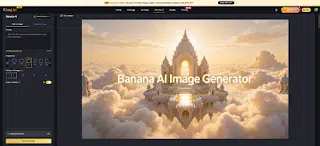
- Go to the Image to Image tab on Kimg AI.
- Upload your reference images (up to the limit of your chosen model).
- Set output quantity — up to four variations per batch — and configure visibility preferences.
- Write a Precise Prompt
- The text prompt field accepts up to 5,000 characters. Use that space intentionally.
- Specify lighting quality (e.g., “soft diffused window light from the left”), surface material, background environment, and any color palette constraints.
- Avoid vague descriptors. “Premium” means nothing to the model; “brushed steel surface under warm studio lighting on a marble countertop” does.
- Generate, Review, and Refine
- Run the generation. Review all output variants before committing.
- If a result is close but not quite right, use the Pro Redo feature to push detail fidelity further without starting over.
- Repeat with adjusted prompts until the shot matches your brief.
IV. What the Banana AI Image Generator Actually Does Well for Product Work
Beyond the technical specs, here’s where the Banana AI Image Generator genuinely earns its place in a commercial workflow.
- Background Replacement at Scale
- Upload a product shot, describe the setting, and the model handles the compositing.
- Results maintain the product’s structural integrity — edges stay clean, reflections behave correctly.
- One product can appear in a dozen contextually different environments within a single afternoon.
- Style Transfer for Brand Consistency
- If your brand has a defined visual language — a specific color temperature, a recurring texture motif — you can encode that into reference images and prompts.
- The Banana AI Image Editor functionality allows targeted stylistic changes without altering the product itself.
- This is particularly useful when localizing campaigns for different markets that require different visual contexts.
- Multi-Image Composition
- Nano Banana 2’s 13-image input capacity isn’t just a spec — it fundamentally changes what’s possible.
- You can feed in the product, a background scene, lighting reference, texture close-ups, and color palette swatches simultaneously.
- The model synthesizes all of that into a single coherent output, reducing the need for post-production compositing.
V. Practical Tips for Getting Consistently Strong Results
Using a Banana AI Image Maker effectively is partly about the tool, partly about the inputs. A few practices make a measurable difference.
- Shoot your product cleanly first. The model enhances and contextualizes; it doesn’t rescue poor source material. Sharp focus and accurate color in the original image carry through to the output.
- Be specific in prompts. Mention the exact surface, the time of day implied by the lighting, and the intended emotional tone of the scene. The 5,000-character prompt field exists for a reason.
- Use the full reference image allowance. If you’re on Nano Banana Pro, upload all 8 slots. Redundancy in references reduces compositional surprises.
- Batch variations, then select. Generate four variants per run and treat it like a contact sheet. You’re looking for the strongest candidate to refine, not expecting perfection on the first output.
- Iterate, don’t regenerate from scratch. The Pro Redo feature preserves the structural integrity of a good-but-not-great output while sharpening details. Use it before abandoning a direction entirely.
VI. Who This Workflow Is Built For
The combination of model tiers, high reference image capacity, and 4K output makes this approach viable for a wide range of e-commerce operators.
- Independent sellers who can’t justify studio costs but need professional-quality imagery to compete on crowded marketplaces.
- In-house marketing teams managing large SKU catalogs that need consistent visual treatment across hundreds of products.
- Agencies handling multiple brand accounts simultaneously, where speed and adaptability matter as much as quality.
- Brand managers localizing campaigns across regions, where the same product needs to appear in contextually different lifestyle settings.
The Banana AI Image Maker on Kimg AI is built to serve all of these users through the same interface, with model selection acting as the dial that adjusts depth of capability to match the task.
VII. The Real Cost of Not Updating Your Visual Strategy
Product imagery isn’t just decoration — it’s often the first and only impression a buyer gets before making a purchase decision.
- Poor product shots communicate poor product quality, regardless of what the actual item is like.
- Competitors who iterate their imagery faster capture attention in algorithm-driven feeds where visual quality is a ranking and click-through factor.
- The compounding effect of consistently strong imagery — across listings, ads, and social content — builds brand credibility over time in ways that are difficult to reverse-engineer quickly.
Adopting a tool like the Banana AI Image Generator on Kimg AI isn’t just an efficiency play. It’s a quality floor that moves with your production volume, rather than against it.
Conclusion
Studio photography had its time. For most e-commerce teams today, it’s an expensive constraint dressed up as a standard. Kimg AI‘s Banana AI suite — from Nano Banana through to Nano Banana 2 — offers a structured, scalable alternative that doesn’t ask you to compromise on output quality.
The workflow is straightforward: clean source material, deliberate prompts, the right model tier for the job, and a willingness to iterate. Do those four things consistently, and 4K product imagery stops being a budget line item and starts being a repeatable internal capability.